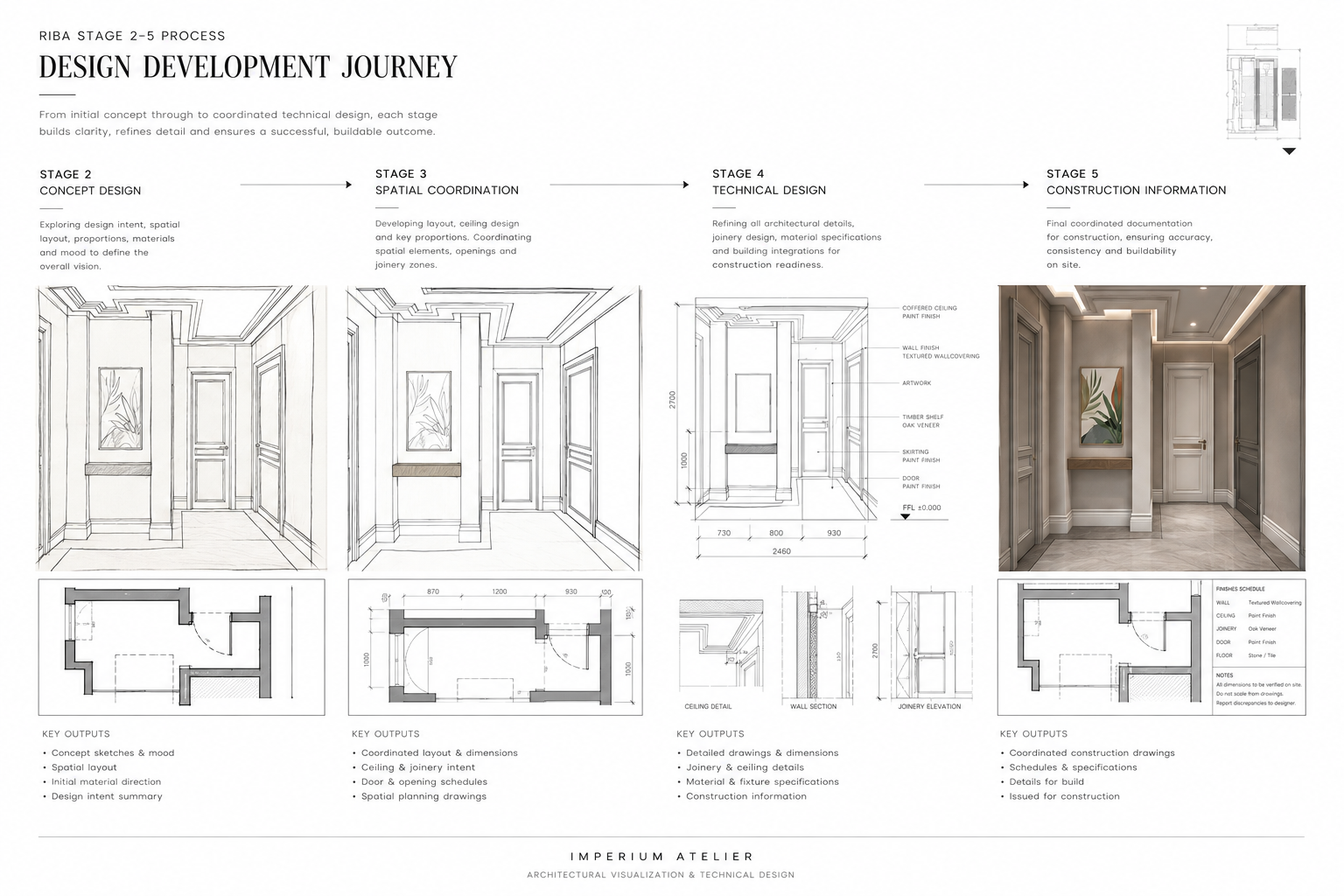
As a project progresses through the RIBA Plan of Work, the type and level of information required changes. Understanding this progression helps studios plan their production workload more effectively.
ARTICLE:
A project does not require the same type of information at every stage.
Early design work is about establishing the brief, concept and overall direction. As the project develops, information becomes progressively more detailed, coordinated and suitable for delivery.
For studios working across multiple projects, understanding this progression is essential for planning production resources.
STAGE 2 — CONCEPT DESIGN
At Stage 2, the design begins to take a defined form.
Typical work may include:
Spatial development
Plans
Key elevations
Design studies
Material direction
3D modelling
Visualisation
At this point, visualisation can be particularly valuable for communicating design intent to clients and stakeholders.
STAGE 3 — SPATIAL COORDINATION
The design becomes more developed and coordinated.
Information is developed across disciplines and the project begins moving from a design proposal toward a coordinated solution.
Production may involve:
Developed plans
Sections
Elevations
Coordinated models
Interior information
Material development
Design coordination
The emphasis increasingly moves towards coordination.
STAGE 4 — TECHNICAL DESIGN
Technical information becomes significantly more detailed.
Depending on the project scope, this can include:
Detailed drawings
Construction information
Detailed sections
Joinery information
Interior elevations
Material interfaces
Schedules
Coordinated technical information
At this stage, accuracy and consistency become critical.
STAGE 5 — MANUFACTURING AND CONSTRUCTION
The information developed during the earlier stages is used to support manufacturing and construction.
The exact requirements vary according to the project, procurement route and responsibilities of the design and construction teams.
This is why production should always be considered in relation to the specific project rather than as a fixed checklist.
PLANNING PRODUCTION AROUND THE PROJECT
Understanding the progression between stages allows studios to anticipate where additional production capacity will be required.
A project may require strong visualisation support during one period and intensive technical drawing production several weeks later.
The workload changes.
The production strategy should change with it.
THE BIGGER PICTURE
RIBA stages are not simply labels attached to drawings.
They represent the development of the project and the information required to progress it.
At Imperium Atelier, we provide production support across RIBA Stages 2–5, working alongside architecture, interior design and development teams.
THE RIGHT PRODUCTION SUPPORT AT THE RIGHT STAGE CAN KEEP A PROJECT MOVING.
Tell Us About Your Project
Leave a Reply